
The key difference between management consulting and strategy consulting is that strategy consulting dictates the direction of your business; management consulting ensures you get there.
But consulting jargon can get confusing fast, especially when people start talking about role types. Terms like “strategy consulting” and “management consulting” are often used interchangeably.
However, the distinction between management and strategy is not purely semantic.
These two consultants actually provide businesses with two distinctive yet equally important functions. In some ways, this can be described as the 'how' and the 'why' of business.
Strategy consulting is the ‘why should we do this?’
Management consulting is the ‘how are we going to do this?’
We’ll sketch out these roles in a little more detail below, and offer guidance on which type of consulting might be most beneficial for your business.
The core of management consulting vs strategy consulting
When describing these roles, it’s hard not to generalise or ignore the fact that there’s a lot of overlap between the two functions.
However, we can generally describe strategy consulting as more top-level, visionary thinking; it focuses on a business's long-term strategic direction. This could include things like market penetration or growth strategies.
Management consulting, on the other hand, is responsible for executing the strategy. It advises a business on where it can make improvements, typically in its day-to-day operations, whether in product, marketing, or other areas.
There’s a lot of debate on which of these functions is more important. But there’s no doubt that alignment between the two is essential for growth. One of the best quotes to describe this is from the Founder & Chairman of TMSC. Morris Chang says,
“Without strategy, execution is aimless. Without execution, strategy is useless.”
We’ve highlighted this relationship in the visual below.
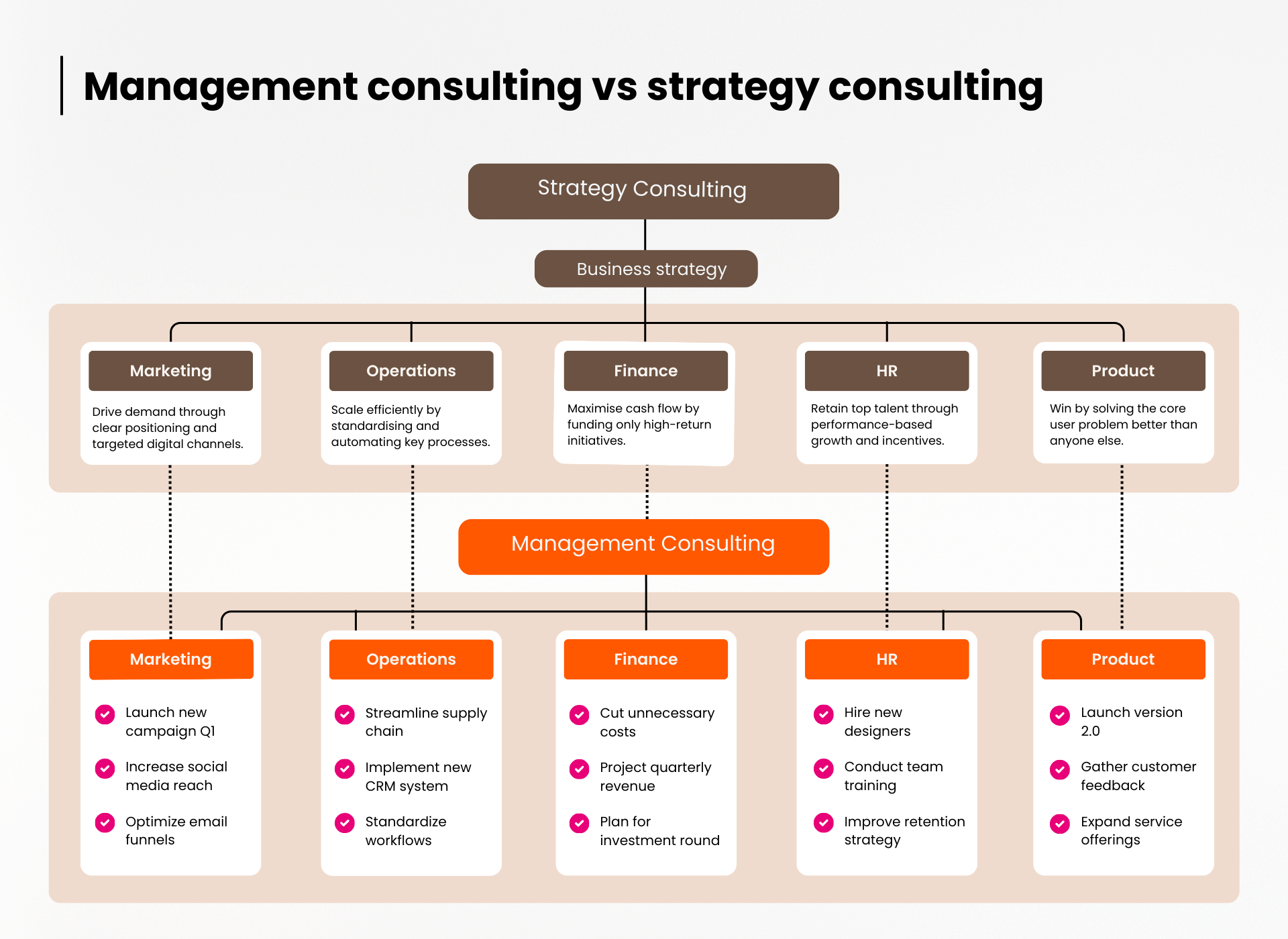
Here, you can see a little more clearly that the business strategy will set the tone for the rest of the functions, but what you actually do sets the tone for business growth.
How not to sell mango smoothies
Consider these two scenarios.
You run a mango smoothie business and position yourself as a “healthy yet affordable alternative for smoothies”. But:
Customers notice that you’re actually using 25g of sugar in each 250ml bottle, so you aren’t really that healthy.
Mangos are also quite expensive as a base ingredient, and you realise that while scaling, you’ll have to increase the product cost, and suddenly, you aren’t inexpensive anymore.
You’re unaware of who your real competitors are, only to later discover you’re competing with established brands like Innocent (it’s a tough market!), and now you’re wondering how to differentiate.
This isn’t an execution problem. It’s a strategy problem. Without clarity on positioning, pricing, and competition, operations have a huge job to try to make a business with poor vision actually work.
Now consider the opposite scenario: your strategy is strong. You understand your customers, competitors, and costs, and have a clear roadmap for growth. On paper, everything makes sense. But:
Execution is weak, and orders are delayed because your legacy CRM keeps making mistakes.
Product quality suffers because the supply chain isn’t delivering fruit fast enough or in a fresh enough condition.
Eventually, customers grow frustrated, and your reputation starts to slip. Ultimately, businesses need both functions to succeed.
How to decide which consulting you need
When a business seeks consulting support, it has recognised that the expertise it needs cannot be fulfilled in-house. That’s not a weakness, sometimes you need:
Objective advice, which is harder to achieve when you work every day on a product or service.
Interim expertise, in situations where it wouldn’t make sense to hire someone full-time, in-house.
Specific knowledge, which in-house employees might not have.
Both management and strategy consultants are popular choices for businesses. But how do you discern which you need - if not both?
When you need a strategy consultant
For CEOs or executives responsible for strategy development, the need for a strategy consultant arises when the clarity of direction is unclear or the business faces complex choices.
As Michael Porter famously said, sometimes “The essence of strategy is choosing what not to do.” Strategy consultants can help you define business priorities and identify where to invest resources for maximum impact. Strategy consultants help leaders answer questions like:
What markets should we enter or exit?
How do we beat our competitors?
Should we acquire another company?
What should our 3–5 year vision look like?
Don’t forget you can also make the expertise more granular. While the business strategy sets the overall vision, strategy also filters down into every business speciality, like tech strategy consultants, marketing strategy consultants, and others.
This might be necessary when you need to tackle a niche functional problem.
Case Study | Blockbuster’s Strategy Misstep

In the early 2000s, Blockbuster was the dominant video rental chain, with thousands of stores worldwide. Its strategy was focused on physical rentals, late fees, and in-store convenience. But it made a big mistake; it failed to anticipate the shift in consumer behaviour toward online rentals and streaming.
The chain was given a lifeline when Netflix approached Blockbuster with a partnership and even an acquisition offer, which Blockbuster famously declined.
Instead of innovating, Blockbuster stuck to its traditional model, charging late fees and relying on walk-in traffic. This strategy felt “safe” and comfortable for the business, but it ignored 3 crucial and emerging trends of the time: the rise of digital distribution, customer preferences for convenience, and the competitive threat of subscription-based models.
By the time Blockbuster tried to pivot to digital and mail-order rentals, it was too late. Netflix and other streaming services had already captured market share. The result: Blockbuster filed for bankruptcy in 2010.
Lesson: A strategy that doesn’t account for changing market dynamics or technological disruption, even if it works in the short term, can be catastrophic – stay agile.
When you need a management consultant
For COOs and operational leaders, management consultants are most valuable when execution is the bottleneck.
Another famous quote, this time from Thomas Edison, says: “Vision without execution is hallucination.”
Management consultants help organisations translate strategy into action, improving efficiency, aligning teams, and solving operational challenges. They can bring expertise in areas like supply chain optimisation, process redesign, IT implementation, and HR operations.
In short, if your organisation knows what to do but struggles to actually do it, management consulting is the right choice.
Case Study | WeWork’s Management Failures
A great example of poor execution is WeWork. The organisation grew rapidly in the co-working space industry, reaching a valuation of $47 billion at its peak. Its strategy, offering flexible office space to startups and enterprises, was compelling and needed, but the execution and management were flawed.
Key management failures included:
Poor financial discipline: WeWork’s leadership aggressively expanded into new markets without ensuring profitability, burning billions in cash.
Lack of operational oversight: Many locations were overbuilt, under-utilised, or poorly managed, creating inefficiencies across the network.
Leadership missteps: CEO Adam Neumann made erratic decisions, such as personal real estate deals with the company, eroding investor confidence.
Even with a strong strategic concept, bad management, misaligned teams, and poor financial controls caused the company to miss targets and nearly collapse, forcing a dramatic bailout and restructuring.
Lesson: Execution matters. Even with a good strategy, weak management can turn opportunity into crisis.
Remember that consultants don’t fix problems; decisions do
It’s important to remember that consultants provide insight, frameworks, and typically experience, but they are not responsible for making decisions.
The true value lies in leaders acting on the guidance provided.
Successful consulting engagements happen when:
Leadership owns the outcomes
Asks challenging questions
Drives implementation
When you work with a good strategy consultant, they’ll help clarify choices, while management consultants translate those choices into operational reality. Both are tools, but not substitutes for business leadership. At the end of the day, you should know your business better than anyone.
FAQs: Management Consulting vs Strategy Consulting
What is management consulting?
Management consulting helps organisations improve how they operate day-to-day and how they deliver results. It’s focused on execution: fixing bottlenecks, improving processes, aligning teams, and making sure plans actually get implemented, and how this will be achieved.
What is strategy consulting?
Strategy consulting helps leaders decide where the business should go next and what choices matter most. It’s focused on direction: defining priorities, making trade-offs, and setting a roadmap for sustainable growth or competitive advantage. The focus is more on the “why are we going to do this?” and less on the “how,” as with management consulting.
What’s the main difference between strategy consulting and management consulting?
In simple terms:
Strategy consulting = “What should we do, and why?”
Management consulting = “How will we do it, and how do we do it well?”
Strategy sets the destination; management consulting helps you build the engine and drive there.
Is strategy consulting “better” or more senior than management consulting?
Not inherently. They solve different problems. Strategy can feel more “top-level,” but it’s only valuable if it leads to action. Management consulting is often where value gets captured because it turns decisions into measurable outcomes.
When should I hire a strategy consultant?
Bring in strategy support when you’re facing big decisions or uncertainty about direction, for example:
You’re unclear on your positioning or differentiation
You’re deciding where to invest (or stop investing)
You’re considering new markets, products, or acquisitions
You need a 3–5 year plan that’s grounded in reality
When should I hire a management consultant?
Bring in management consulting when you know what you want to achieve, but execution is the constraint, for example:
Projects keep stalling or slipping
Teams aren’t aligned on priorities or ownership
Operations are inefficient or inconsistent
You need to deliver a transformation quickly (systems, processes, org design)
Do strategy and management consultants ever overlap?
Yes, there’s often overlap, especially in transformations. Many projects need both:
Strategy to define the right direction and choices
Management consulting to implement, embed change, and track outcomes
A strong engagement often moves from strategy to execution without losing momentum.
How do I tell if I have a strategy problem or an execution problem?
Here’s a quick test to help you identify which type of issue you have:
If your team can’t agree on priorities, positioning, or what success looks like, it’s likely a strategy issue.
If priorities are clear but results aren’t happening due to process, systems, capacity, or accountability, it’s likely an execution/management issue.
Many businesses have a mix, and one problem can create the other.
Can a consultant “fix” the problem for us?
Consultants bring frameworks, experience, and capacity, but leaders still make decisions and own outcomes. The best results happen when internal stakeholders:
Commit to choices
Act on recommendations
Sponsor implementation and change
Need some consulting support?
At Freshminds, we help businesses to quickly identify their biggest challenges and connect them with the right consultants, whether you need strategic direction or operational execution.
Our agile approach ensures you get expert support without the overhead, whether you need a consultant for 1 week or 3 months.
Equally, we can help point you in the right direction of what support your business might need. With over 25 years of experience in finding the best-fit consultants for businesses - from strategy to management, marketing to tech - don’t waste your time navigating the consulting market alone.
Get in touch today and discover how the right consulting support can accelerate your growth.